03. Decision Making
The nature of action, and in-action. How pursuing goals is really just a bunch of tiny choices.
and how energy can help us along a healing path.
The amount of decisions we make each day is unfathomable, but once we are aware of our thoughts we also become aware of our choice of action or in-action. Our nervous system tells our muscular system how to move our skeletal system to the action we want to take. The flesh in which we find ourselves in is always in pursuit of something thats next, either for more energy, or prevention of something scary happening to us.
So, when expanding into the nervous system for learning about how to decide what to do, I’m going to start with our eyesight. If we orient our vision into a space that we want to go, we’ll go there. In sports, “keep your eye on the ball,” allows our hand to follow, supporting contact with it.
Science also shows us that when we spend time focusing on something just beyond our reach, our autonomic nervous system (the one in charge of things thats are automatic like heart rate and urination) recruits an increase in epinephrine, adrenaline and our blood pressure. Along side this energy is also dopamine, a chemical messenger that tells us “we’re ready to pursue,” that; proving to players that the moment of focus on the target before the serve, free throw, or at-bat, is best staring down the target to engage more focused energy into the action.
So in goal pursuit, when we want to accomplish anything we’ll see it in our “minds eye.” ~a day dream. It’s almost as if a thought turns into a movie so we can see our future self successful in a way our current path couldn’t put us on. Similarly, if we don’t want to do something, we also spend our mental energy or “alertness” on building all the things that could go wrong~ anxiety. We have these visions because they’re in the same circuit or cycle in our brains. Starting central in the amygdala, a space of reflex and instinct, moving a thought from “ah!, I can’t stay here,” through the ventral striatum in almost a catapult effect, out to the frontal cortex just behind our forehead, as if it looks out and says “how are things out here?” and then it moves into the back of the brain for action, or in-action. This process of turning a thought into action can have influential power when we can catch the flow.
When we use these visions of dreaming of an action or lifestyle we want, and the fear of all the things that could go wrong, together with intention, achieving our goals will be more likely. This is because we are predicting possible failures along the route to success. But, if we stay listening to our anxiety, it becomes a disorder, and sometimes can lead into depression~we stay stuck down low, listening to these gremlins of negative self-talk, and this becomes a habit of our mind. (!)
So, growth happens when we create a plan around the hypothetical negative outcomes to continue to work towards where we want to go. By seeing a potential problem, we can presumptively make an alternate route! Here, begins the mindful habit of problem solving.
Q: So why in the world are we still doing S.M.A.R.T. goals if predicting potential failures isn’t even a category in the SMART plan? A: Because it’s catchy, and goal pursuit is in alignment with satisfaction, a “macro-nutrient” of happiness. We can’t do away with it, generally, but we do need a method for curating alignment with who we are, and where we want to go, that’s more than smart, and sustainable.
Similarly, another acronym I want to update is the D.E.C.I.D.E. model for making a decision, taught in the average 9th grade Health class, usually around week two. Step 1. D stands for “define the problem. 2. Establish details. 3. Consider alternatives. 4. Identify the best alternative. 5. Develop and implement a plan of action. 6. Evaluate and monitor the solution and feedback. Pretty similar to the scientific method, though in real-time, practicing making health-enhancing decisions is not easy because often it’s choosing to do the hard thing.
It’s my understanding that as a culture, our programming for planning our life was installed (maybe) when we were 14 years old, a time when peer pressure, and learned independence were an influence to the choices we made. With the “wrong crowd” easy dopamine access, and a quick resolution were presented as solutions to problems and unpleasant feelings. Ignorant to the gravity of consequences our future health, and unable to create the courage for a conscious decision to do the thing that requires more effort and time.
As a teenager before leaving the house, my mom would say “make good choices!” I would silent-chuckle thinking they’ll make me feel good right now..!, making choices that fulfilled my immediate needs of joy, connection and food. While a positive sentiment from my way out, I know this teenage act of rebellion is where all of my bad habits were started. As a teacher, I decided to do better, and tell my students before they left my classroom, “make healthy choices!” To which they would call out their friends who typically didn’t—elbow nudge, “Yeah Aiden!” positive peer-pressure can be a thing too.
With this learned need to “fix,” feel, or ignore the feeling by engaging in a learned behaviors like drugs, sex, or even shopping, what we’re left with as an adult is an imbalanced teeter-totter of homeostatic dopamine (the messenger of pursuit). We are constantly on the rise and dip of finding the next fix. We’re addicted to the choice of control, and then loosing the control. Our re-alignment for this is acceptance of where we are, and choosing where we want to go, believing a beautiful and peaceful life can be ours. It’s taking honest moments of reflection and having hope for our life opportunities, and the courage to say, “I can do this.”
An updated acronym for a more regenerative and intuitive, decision-making model is N.R.G. [Notice. Re-align. Grow.]
NRG, an acronym for choosing to slow down to notice what’s going well, & what’s not. Notice what we feel or sense, what’s around us, who our choices will impact. To “Re-align,” our actions or thoughts into something that enhances our health, allowing us to change in a direction of growth and influence. All with intention, by reframing our attention. This can be done any moment as good practice, and also weekly, and seasonally. As we spend a moment to take note of what we’ve done, or what we need to do, planning out the week is the process of visualizing what we can do, have to do, what could go wrong, and how to plan around it. Each week, adding a new perspectice to deeply integrate this new action down into a reflex, as opposed to a choice. I believe this to be a system of mindfulness to empower our sense of balance for strength in the tension of life. Meditation, counsleing, and journaling have all worked for me, to see my habits and extract them from my reflexes enough to be in control of my actions. Below is access of my curation for this NRG model for creating health-enhancing habits.
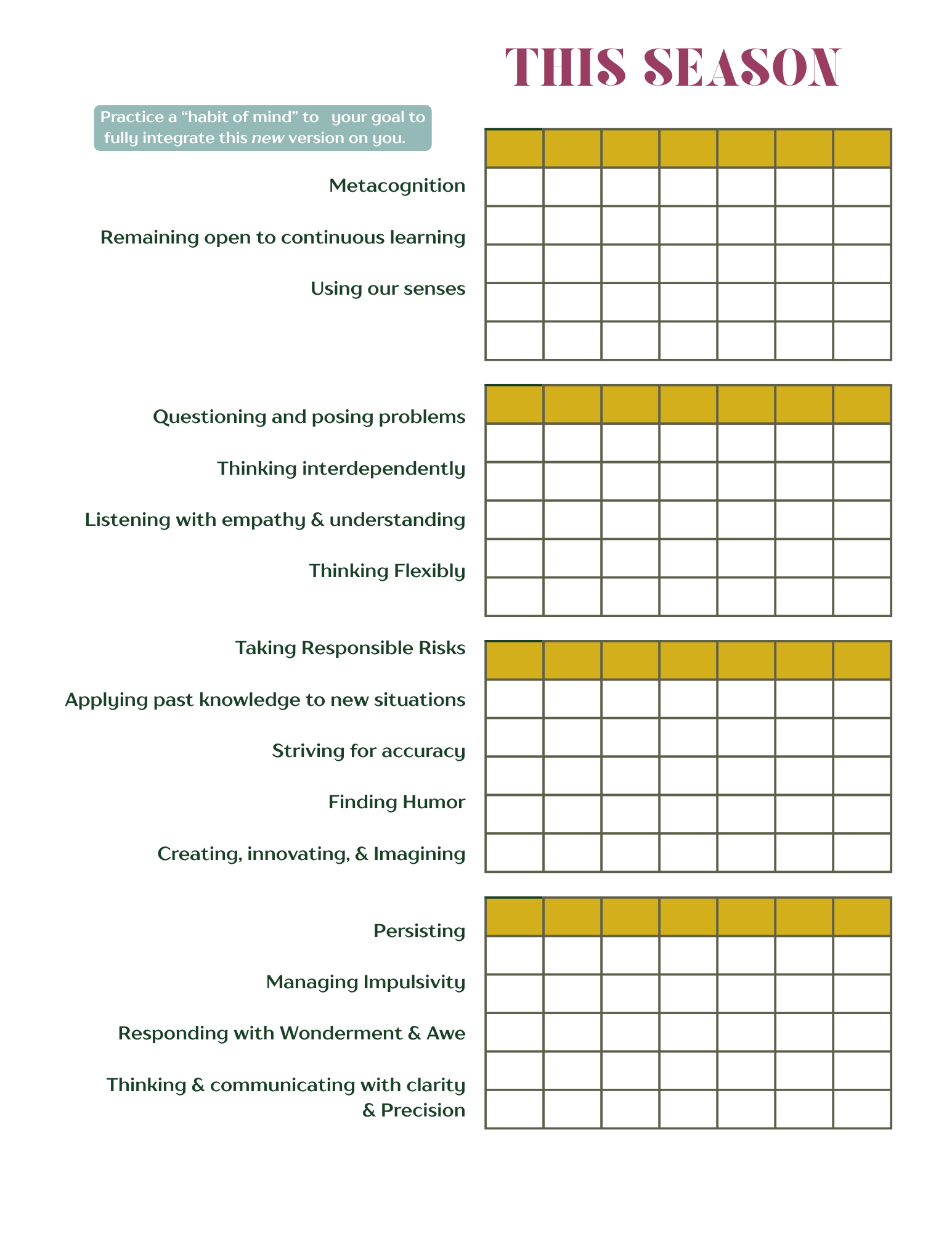
4 month planner, with 0 preset dates, available to start writing in WHENEVER you decide to let go of a habit to move into an healthier version of yourself. No more waiting for a new planner for the next year. Each week, there is a “habit of mind,” related to growth to allow the integration of who you want to be, into who you are now. There is a season overview page, with all four months, a month over view page to plan bigger ideas, and a week-by-week section to write in the details of your life in time-blocks for each day for greater alignment in your growth. Blank cover, spiral spine, and color print for a varied vibe each month.
I come to these articles/newsletters with a desire to inspire us adults to continue to take control of learning more about ourself because I fear a lot of my students really just passed the class because they wanted the GPA. So I’m wondering, how everyone is doing as adults in this world of limitless health information, and not enough guidance on what to do with it. It’s unfortunate because society puts the pressure on perfection and performance that stepping into self-care can be exhausting even thinking about if it wasn’t a priority as a teen.
In alignment with this newsletter name “decomposition, let’s reframe self-care as selfish and agree that caring for all of our dimensions of health is time well spent, and our health is worth the effort.
Before moving into the usual health enhancing activities to try on this week, I want to speak for people with Substance Use Disorder, and the 57.9 million housed people in the U.S. who binge drink, and say that choosing to drink isn’t really a choice, it just happens. One after the other, sometimes we want to continue, sometimes theres a voice we hear that says “I should stop, but why?” and sometimes it’s so integrated into our space that we don’t even realize the effects of it, and what our life can be without it.
Sometimes this homeostatic teeter-totter is so far off the fulcrum that healing from it seems like it’s not even our path, it’s “just the way things are.” Dr. Anna Lembke MD. and author of “Dopamine Nation,” describes a conversation with a patient of hers who doesn’t want to quit marijuana because she doesn’t see the problem, but when asked a question, “do you see yourself smoking this much in 5 years? 1 year?..” The answer was no, it’s not sustainable, it’s actually overwhelming to think about how much time and energy is spent on consumption of maintaining baseline using the substance, so why not stop now?
Until we completely remove the substance from our environment, our mental thoughts, our social circles, and our physical bodies for at least 21 days, the belief of sobriety seems out-of-reach. But, now that we know, if we can focus our vision on something out of reach, internal energy kicks our body into action to work towards our goals and dreams, turning “I should have’s” and “what if’s” into action steps to accomplishment. With awareness of this discomfort, ease actually takes over, because it’s in the knowledge itself that pulls courage into play. When we bring our attention back to our eyes, if we can see the reminders of who we want to be, and where we want to grow, our starts to choose the action we want, instead of the actions we burried into our subconscious reflex.
This is why I believe using a planner and journaling about what we notice internally and externally, can create confidence in the skills necessary to ride the waves of life, or duck our head and cut through the wave continuing our journey out. In our journals, we can see opportunities to choose the right action because feeling good can’t always be our guide, sometimes we have to just stick to the map (calendar in this case.). When health is at the front of the statement, health is aligned to our next action. Taking time each week to plan health enhancing activities in multiple dimensions supports a balanced schedule. Making the decision to act takes energy, so let’s spend it wisely and make healthy choices!
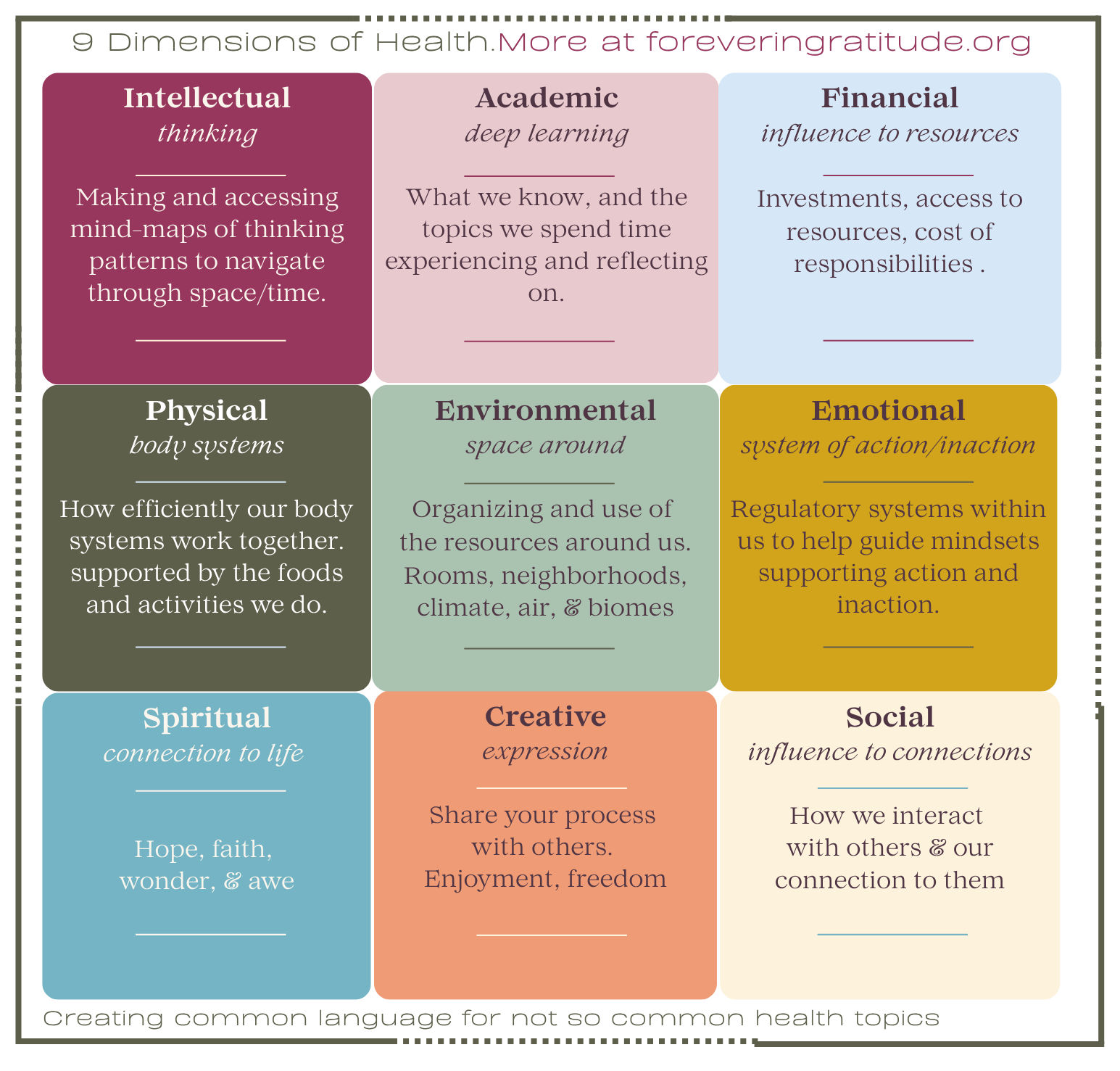
In your week, plan to do at least one separate activity for each dimension of health above.
(Just like you try to have each macro nutrient at each meal. Carbs, Protein, Fat, and micro-nutrients for a bonus: H2O, vitamins &minerals )
Health enhancing topics for this week to decide what to do when we feel low:
Intellectual- thinking
I am unsure about what to do next.
I DECIDE to ask a clarifying question to the group to keep conversation going, get a better feel for everyones input.
I hear a perspective I may have not thought about before.
Academic- deep learning
I am confused with these ingredients.
I DECIDE to look up what an ingredient is, instead of assuming it’s bad. (or good) for me.
I now know where this ingredient naturally grows.
Financial- influence to resources
I notice decision fatigue when choosing what to watch.
I DECIDE on one streaming platform for your movies and shows this month.
I accept my limited options.
Physical- body systems
I notice where my body is in exercise.
I DECIDE to go a little deeper in my squats, lower in your push up, or further in my forward fold, exhale through it.
I rise even stronger.
Environmental- space around us
I feel helpless with all the things I want to change about this world
I DECIDE to go for a walk in my neighborhood.
I narrow down to one thing I can do next that will inspire change for at least one person, even if that is myself.
Emotional- processing systems of action and inaction
I feel unfocused.
I DECIDE to look out my window and focus on something in the horizon.
I return with energy, ready to tackle my to do list.
Spiritual- connection to life energy
I feel violated.
I DECIDE to ask for help, even if that brings up shame, guilt, or other heavy things.
I feel seen and connected, and I might even help others in my same situation.
Creative- expression of life energy
I notice .. nothing.
I DECIDE to do something out of my comfort zone like a new recipe, outfit combo or walking path.
I return with a new experience and maybe a compliment or two.
Social- influence to connections
I notice I was quick to respond and I said something mean
I DECIDE to apologize for saying something hurtful,
“next time I will wait 2 more seconds before choosing to say something.”
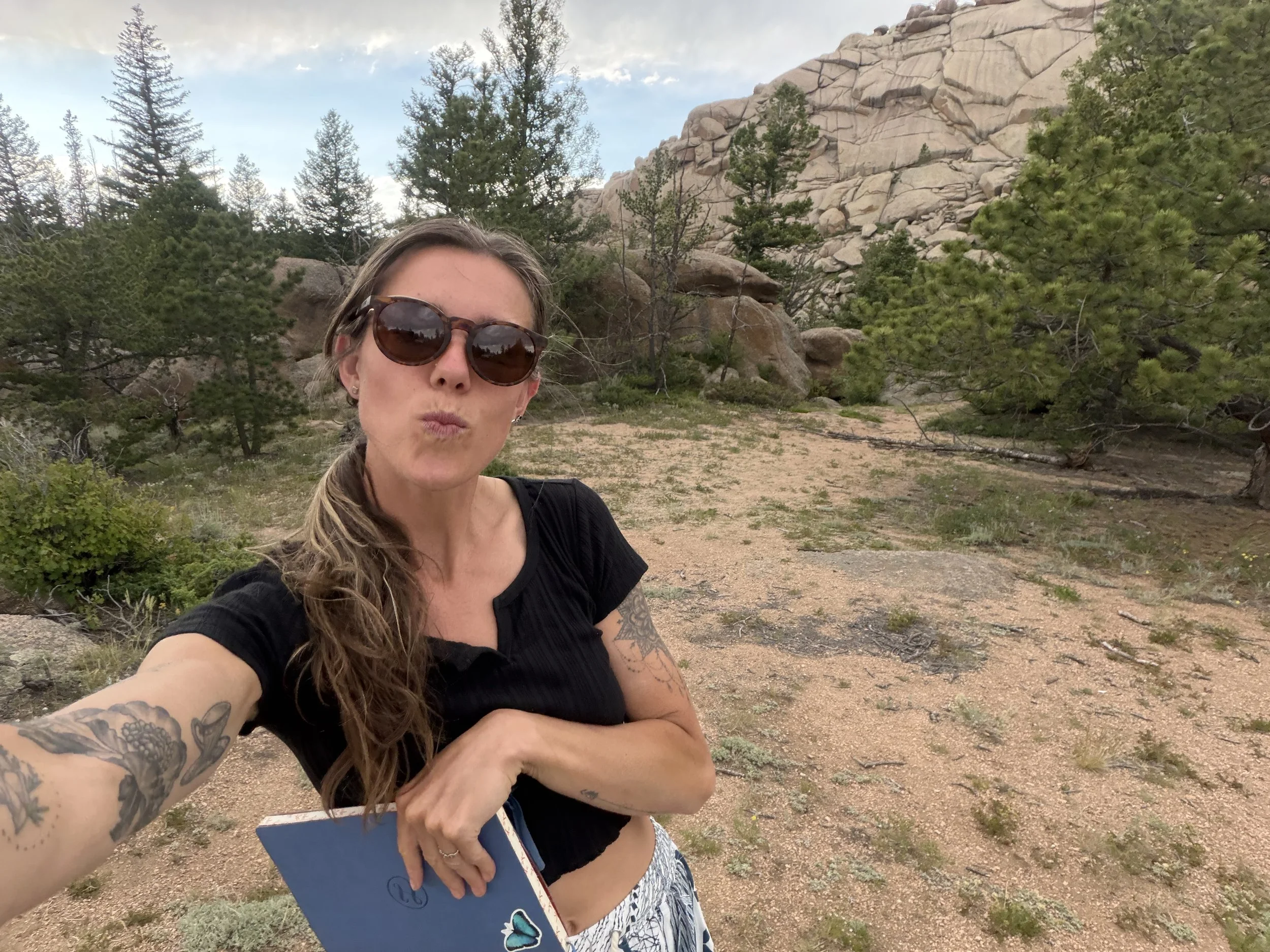
Me and my journal, outside of Medicine Bow Peak, Wy.
With gratitude, Jess.