
*I am not a doctor. This is not my prescription to you. I don’t know you. As you read this article, I hope to prove the power of exercise and it’s ability to help us grow, making life easier in any dimension. Start where you are, and mentally move through the created experiences, stretching your understanding of what movement and exercise are in your life.
As a PE teacher, it was my observation that there is a decline in kids willing to put in work during class, especially post-COVID. It’s an epidemic that has many factors, and I want to get into the significance how this influences you, and also our future. Across my 10 professional years assessing effort and accuracy in skills, I have had to observe and report on data about student’s physical abilities and actions- skills. The brain skills area a mind-body connective ability and I assess these through the brains ability to extend, provide power, and find balance with accuracy regarding muscle memory, in addition to the prosocial behaviors such as collaboration and inclusion (aka, sportsmanship).
Through my teaching career, I have participated in a mental gymnastics of using grading standards bolstered with success scales to report someone’s physical effort and accuracy of all the expected skills. This grading style tears at my conscious Self because in my mind-intellect, I can compare behavior with expected behavior and I can mark where the kid is at with. My heart-spirit pulls in another direction because by adding context of the students affect, family history, and resources add a bias to the report that ultimately influences their opportunity later in life, and their perspective on their ability to enjoy moving their body (for better or worse). Meaning, for a lot of kids, the classes they score poorly in, end up becoming the subjects they hate. It’s not ideal an ideal way to think, but it’s reality, so if a kids fails PE will they hate it forever, how do they bounce back, and is it worth it as a teacher to mark them down for things often out of their control (like being fed enough breakfast to have the energy to participate enough to demostrate their skills)? I can eliminate my bias, and report poor scores, or I can add context to the behaviors that I see in my class, and the student will remain in a positive mindset about their ability to grow in their physical skills, but won’t know they have to grow, and physically feel the benefits of movement. Engaging in this internal battle of “this way or that way, or how can we meet in the middle,” is a mental gymnastics practice that strengthens my ability to “think flexibly.”
The flexion part of this professional practice and analysis has wrung me in my percept because not every family was raised to love their bodies, and in PE that is your “homework” for extra practice. In summary, in case you missed the message for any personal reason in middle school and high school PE here it is: move your body in new ways, often and you’ll have the skills you were meant to achieve through high effort in PE.
When we move our bodies, when kids move their bodies, engage in play, sport, have fun moving, etc… Their brains show up quick, clean, and kind in other areas of their day. I’ve observed strength in voice, esteem, and creativity from kids who have at least one home with outdoor activities and/or team sports. Same is true that kids who do not have the confidence to move throughout the space without a fear of falling, or getting too tired, or doing something embarrassing, these fears are seen in other areas of school too. I’m not saying that kids who do not exercise are not using their brains, but I am saying that
when we use our bodies we are extending our brain, and by extending our brain, we are gaining more learning experiences. we are expanding our mind, and this this really good for learning and adapting to new situations.
Through my experiences of getting to know my students’ stories, I have learned their families, I reflect on how my own family moved, and I see how my step-kids based on both home-influences. I know a kids demeanor on the play field or gym has almost everything to do with experiences they had in the past, and how it related to the current moment. In a sense, I can see the process of energy, where it comes from, and how it’s used.
That’s how we all work. For the most part, we let our past experiences flash to spur action into our future, unless we slow down to train our self to override it. Through choosing a tough action, and working on it with our mind and our body, we can get physically used to it. Playing on a team, or even attending group fitness classes are a great way to override our inner critics and doubts, as long as a coach cultivates this environment. I am here for you if you’ve ever been hurt by a coach/leader/parent/teammate that strayed you away working towards loving to move your body.
As a teacher, with my experience here’s my advice:
Do the work. Lean in. Exercise.
Get your movement in everyday
Stretch. Breathe deeply. Feel your muscles work, and hold them there. Be quick on your feet. Protect your bones. Reach from your toes to your finger tips.
Know your core muscles like the lyrics to your favorite song.
We have evolved as a species because of the act of doing hard work. It’s in our nature to work hard, and the access to consistent comfort of our space is preventing us from growing into our personal potential. Growth happens when we choose to do the work, feel the tension, and override our fears that we grow into a more capable being, able to defend against ailments.
So a question here is: How do I better myslef in any area of my life (Dimensions of health).
Because change is inevitable, why not use our time with in intention an choose where we move.
Answer: change-up a physical health routine. If our body can adapt, so can our mind.
Here are some tips:
When it comes to movement, we have to stay on the move.
And when we rest, we have to really rest.
When this move and rest or “go/no-go,” operational flow of work energy is in balance (not equal, but cared for in the ways we need), these modes of our brain become optimized because our body systems are working together at a higher, more focused rate. Through exercise we are strengthening all body systems. The duality of our sympathetic and parasympathetic nervous systems are in play and practicing being aligned with our thoughts, in the trade off of focused work and peaceful rest.
Picture this:
Our movement forward is a vibration as if we’re jumping on a trampoline wearing a metal jacket with enough mass to let us catch the pull of a magnetic ceiling above and float back down to rebound with might from the trampoline below.
Staying in this mental image, we can create parallel life experiences of those that might create an imbalance in the landing and produce a terrible bounce/rebound. Or do something that that might take us too high, we could get stuck on the ceiling. Our concious state still has control of where we’re floating and we can let the forces of gravity and force from the trampoline push and pull us to be in flow. If we stop the jumping, a restart takes extra energy to get the springs of the trampoline going back again, so resting well is the key to a surge of energy for the next chunk of time on the trampoline to keep extending into our full range of experience.
If growth happens after we extend ourself and come in to rest in a safe space of care and comfort, let’s build on a tangible foundation of what self-care can look like. In Maslow’s Hierarchy of needs there is a represented pyramid of awareness based on things we need as humans. Because we are always changing, so do our needs, so I’m going to add an element of time, thus growth to Maslow’s model. Expression of age-based needs can be met through Eric Erikson’s stages of Psychosocial Development, and further, the described virtues destined to be learned in each of these 8 stage, as well as the “malignancy-” if this virtue is not learned. This dynamic model becomes individualized and continues as time goes on and more things arrive in our awareness to eventually learn, or discern. Kids who do not get the attention they need to learn industry and action, become fearful and reliant on supportive resrouces, instead of learning who they are as a whole as teenagers. This skill, resurfaces in any new environment we move to where we have to show up as ourself.
I’ve observed that at in an elementary age where industry is developed, competence is also learned and if not, then “inertia, (passivity).” This sounds like “I guess I’m just not meant to move my body like this,” and other limiting beliefs. This builds into teens who are responsible for learning about identity and fidelity, knowing how to be strong helps us adapt to different dimensions of life where we need to be strong on our own. As these stages of life continue on through time, new experiences with lessons and mis-alignments can occur and are collected as a sense of Self. However, as time passes, and the more we forget or choose not to work through our identity or competence, the more these lessons will be found in all our problems.
The good news is: with awareness, change can happen almost immediately, as long as we keep choosing change.
So let’s get to work.
It’s important to warm up in mobility first. Find a full range of motion with strength will help prepare our muscular and nervous systems to get our body physically ready to move through any position necessary for the next 20-90 minutes. This applies to any physical and mental task, writing, creating, connecting with god, having a conversation with someone new.
Warm up by choosing engagement and leaning in, find the connection. Then, the goal of the exercise/practice/challenge is to then return to a comfortable state of mind and body, having worked the all body systems through exhaustion. So find the fun. When our body can play safely, our muscles remember how to move, and our mind can extend and open to new experiences. Dance, find a ball, or a partner and manipulate the rules for a common game, doodle, make a joke. Play to warm up, and the exercise can shift our brain states into a mode of focused learning.
In exercise energy flows through our systems, as if these motor-neurons are lighting the way like flamed horses riding to battle in the night. An activation signal to all body systems in sympathetic nervous system- “fight!” An intentional physical warm up to anything our mind wants to grow in can help integrate and maneuver new things into our Truth.
Engaging in a warm-up that an educated coach designed for you can truly activate growth because in the extension from the mind, “read/listen to the directions,” then follow through with my action, in ‘this’ way, at ‘this’ effort, is a way to gauge how connected to my body, and my capabilities/possibilities. Once we warm up to play, a full systems engagement activates:
[ a learning state of the body —> mind ]
focused tunnel vision—> distractions away
increased heart rate —> warm body, mobile, manipulatable,
felt range of motion —> understanding the rules and principles, walking on the edge of them to see what else is out there.
digestion haulted —> no processsing now, recieve and perform/play/output.
When more power is applied to a familiar actions, that pathway becomes strengthened through proper repairs (rest), just as a well maintained trail in the woods, this path becomes more accessible for all. This is why “any movement is good movement,” is a great way to start this journey of incorporating exercise more into your daily routine.
The problem that I saw in experience was that kids had to learn to do physical exercise through a screen, or from someone they didn’t trust, this powerful feeling of mental and physical exertion can be unfamiliar, or even fear invoking because they didn't have others around them showing and encouraging them, that it’s okay to feel this way. We know exercise is good for us, but we don’t feel the benefits of it, because we don’t do it, a gutting paradox that has to be physically learned to understand it. This becomes an intellectual understanding, but not an experiential understanding, and then it becomes bigger problems for us in the long-term, as opposed to a protective factor against many ailments. So maybe, feeling is believing.
A sensation to understand:
The charge using our muscles is hot, the brain to bone reaction is tingly and lively, and the piercing extension of our lungs at the top of a deep breath is snapping, and almost a blood-metallic like taste. These aren’t “good feelings-” because there aren’t “good” feelings. These things we sense tell our mind what our body is feeling. Systems are in work mode. These are as they are, and when we learn these feelings, it’s those people around us that give us little encouragements to keep at it, change it this way for this result, or here’s what you can do next! We can override previous experiences of doubt, embarraassment, or whatever negative things we told ourself when we engage in exherted movement.
The experience is understanding and recognizing and exploring the sensations of the moments we’re moving through. It’s feeling our tendons move our bones into place, it’s taking dry air, it’s the release of the tension after the threshold has been surpassed, supporting our ability to move the weight. Doing things we didn’t think we could gives us confidence to do other things we’ve never experienced before. This “industry,” into “identity,”in action, and “grit” becomes the armor of our mental flexibility. This transferrable mindset of our body in action, we can override our mind and it becomes easier when we are around others.
In 9th grade a joined a club volleyball team that played in the high school off season, which meant I was getting serious about wanting to be better in this sport, I had made the switch from softball to volleyball after trying out all 4 sport seasons for my middle school. I was well behind in technical skills, but “athletic” enough to pick it up to make a team. Coach K taught us many lesson I remember daily, but one in particular is what I will expand on here:
Vizualize success.
And create visual reminders to visualize specific things. Visualization is the important skill because as a teen, we don’t want to do what adults tell us we need to do, we do things becuase we want to. I learned that if I can visualize this, I can visualize anything.
the practice:
Around my house I put index cards of phrases that reminded me of the areas I wanted to grow in. Near my tooth brush: “I serve over the net with power.” In the cup door: “I talk to my teammates.”.. etc. I had to stay in that mind-movie for 10 reps. (10 successful serves, 10 high fives..) These visual exercises were mental reminders of how to move my body into action, without actually going into action. Saving physical energy such as carbs and oxygen, but expending mental energy sitting in, and creating a scene in my head that is positive and aligned with who I wanted to be, later in the game where it’s rewarded to do well. Building up my mind energy created a tolerance and expansive net of experience for when I physically participated in these dream-like actions. I got good, and I learned how to connect my mind to my body, and felt strong doing it.
Change it up:
In 2010, I was in12th grade and just finished volleyball, sour at my coach I quit volleyball. As a moody teenager, I still needed something to do.
I got influenced to do CrossFit as training and as sport. Coach Cody provided a space where people were welcomed, met where they were at, and the he encouraged us along the way. I was quick to learn any new movement the hopper threw at us. It was in this modality of being ready for anything that tested us physically and emotionally. I learned that specialization doesn’t mean we’re the strongest overall. We have to be able to use our systems, and" “work across broad times, and modal domains,” if we want to be the fittest. For context this was at the beginning of CrossFit becoming world-wide “Games,” where competitions of fitness were popping up in warehouses and ranches for fun. This is what I did in my free time, as a young adult. I chose the Paleo diet, and eventually experimented with other sugar detoxes to devalue the taste and experience of sugar. I created a whole food pallet that I adopted as a college-aged athlete that consisted of perfectly weighed “zone meals.” Yes, it was me eating the tuna and pickles with a spoon in between bites of microwaved sweet-potatoes, sipping on my grass-fed whey protein powder, chasing it with flavored fish-oil. I figured out how much my body needed, and worked from there. Not in a mis-aligned way, but in a way that expanded a base model for efficiency.
I learned that only when we know how our skeletal system moves, we can build from there. But moving through full range of motion, with power, takes work. and to push passed the discomfort of work being done in our body we have to choose these feelings of heat, tingly, pokey because it just means that they are working. This is living.
This was inspirational.
Practice this-
Stand tall on one foot right now if you can, take off your shoes and feel the tension change from one toe to the next as your weight shifts through the air, leaving you balanced, or off-balanced. Extend an arm up or out, hold it there. Continue to notice the change. Close your eyes and repeat. Manipulating these variables expands our abilities and increases opportunity for success when anything is thrown our way.
Application to life:
The pathway to healing, from anything, starts with awareness. and then there has to be some incentive to want to get better, to move better. When we become more acclimated to choosing the new, uncomfortable feelings, the easier new expereience are to welcome, and change becomes a thing we look for, rather than run away from or hold onto.
The experiential understating of growth and change is quickly learned, felt, and activated when play is a normal part of our routine, and it’s chosen over and over again if it’s a positive space to be. I recognize that play is a privilege, and is not supported everywhere, but it can be a mindset through visualization, and a shift in awareness.
We start by changing our posture, taking a deeper breath in, and extending the exhale, give it an audible exhale, hum or even yell. Then, get a good look at the principles, guidelines and rules in front of us, and find the flow and movement between what we can do with what I have. Take note of new things we experience, and continue moving.
In our sensory system, we have our vestibular system, which supports our sense of balance. It’s a slosh-pipe [see bottom of page] that helps our dark brain recognize which way is up. In parallel to our mental life, balance is extending ourself, changing our perspective, and returning to center, upright, and collected.
In japan there is a phrase “misogi,” which is to take one thing that you truly fear, and work to not be afraid of it any more. Do it for seomthing important like getting over our fear of speaking in front of people, or small like trying a food. The idea is that we are purposfully engaging in overcoming fears, to beable to handle fearful things that naturally come up and typically knock us down. The reward is net positive becuase it builds other systems up, and this is worth investing in.
In yoga- there is the second limb- Niyama, meaning self-discipline. It’s holding ourself accountable to do the things that bring us closer to peace, through personal growth. Practices and virtuous habits can include:
clearness of mind, speech, body.
acceptance of circumstances
self-discipline
study of the Vedas (life energy and elements) introspection of self thoughts..
recognition of being and True Self.
It’s a practice of seeing ourself, and choosing our action. Yogi culture demonstrates one that integrates movement into daily practice, and with an open mind, we can use this behavior as an example for a positive perspective on life support a goal of growth, not for perfection and domination, but for improvement of self abilities, so maneuver through life with ease and comfort, by choosing discomfort.
Here are more expansive ways to practice growing, changing, and doing hard things.
Incorporate these into the start of your day, end of the day, or to bridge the morning to the afternoon, or afternoon to evening.
Academic- Work through distraction. Grow in setting a timer, and staying focused on something like reading, or whatever else is hard for your naturally to sit through, despite knowing it’s good for you.
Creative- Work through doubt. just get going. move. stay in motion. let your dance moves be choppy. let your drawings be sloppy. repeat something with a little more attention, and watch as the skill is improved, cultivating confidence.
Emotional- Work through anger. Feel the fire rise, feel the tension. choose something that moves your body enough to where you have to find rythym in deep breathing. choose cardio (biking, hiking, runnning, swimming, rowing, jumping, hula-hooping…)
Environmental- Work through shame. Pick up garbage, move the fallen leaves off the storm drains, organize your stuffed closet. As you do, find your shadow, the things that makes us feel inferior to those around us, and sit with it. recognize it, and call it as it is. once the task is complete, don’t spend more attention on this thing that gives us shame. it now no longer gives us shame, because it is what it is. This works becuase acts of kindess for others tilts our brain network into a state of positivity.
Financial- Work through worthiness. Go to the fitness center, a group exercise class, find the free yoga sessions or pick-up game in the park.. Do this with a mindset of because I can move my body, I should, this is good for me.
Intellectual- Work through weakness. Find a routine of isometric holds. choose 3 poses, and hold them there for as long as you can. each attempt, try for longer. Examples can be a plank, or side plank variations, a hovering squat, or even mountain pose. The goal is to build length in time on a hold where you are flexing your muscles.
Spiritual- Work through sadness. Find a park and walk the trail. walk the perimeter. follow a path so that your body can move, and your mind can wander. Keep choosing to look at the nature around you. notice the leaf structure, floral color, and the stages of life the different plants seem to have. Breathe deep in the outdoors.
Social- Work through fear. Stand tall, and engage your core when you speak. dont be afraid of what you say, you can always maneruver around the conversation that stems from it. Often the hardest part is getting something to come out in the first place. Posture matters, and then confidence will follow.
Physical- Work through boredom. Pick up the nearest thing that doesn’t “belong” where it’s at. Put it away. Find something in that location, pick it up, and put it away. follow this for 10 minutes. this is called “tidying,” and can be done to reset your body systems, and get them aligned again.
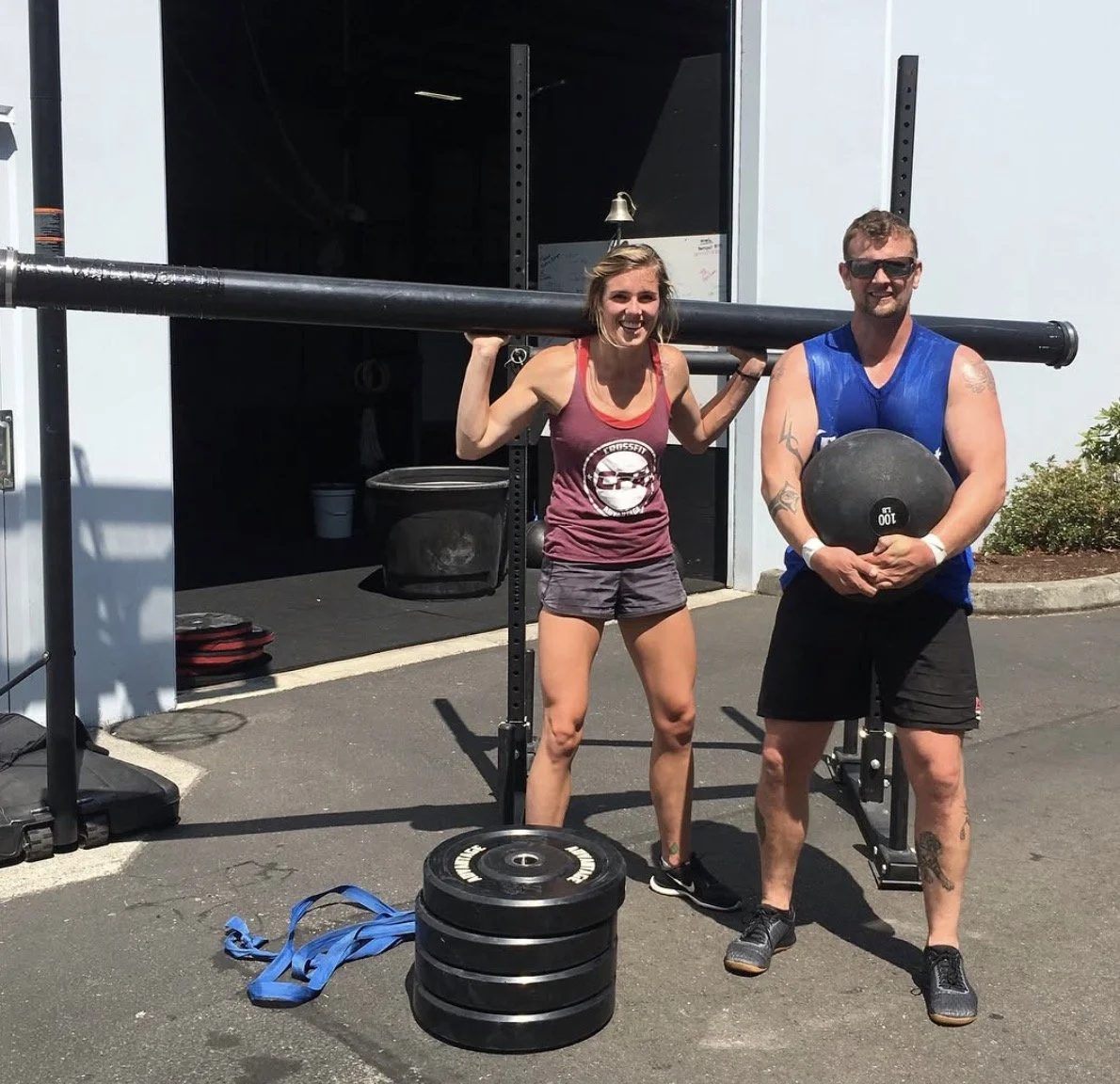
Me, left with slosh pipe. About half the space inside of the PVC that is capped is filled with water. So movement “sloshes,” around.
Coach Cody, Right, outside of his gym CrossFit Advantage on “odd object day”(aka, pick us something and move with it). circa 2018.